The Series Project: Star Trek
Film article by: Witney Seibold
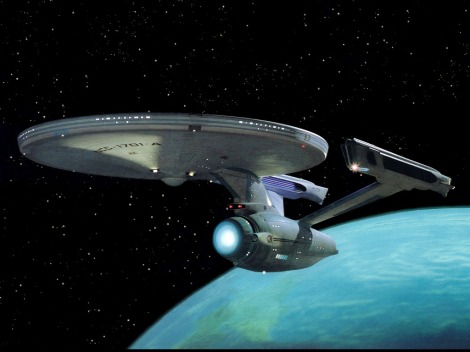
I have admitted in these hallowed Internet pages that I am a hardcore Trekkie. So hardcore, in fact, that I say “Trekkie” and not “Trekker.” I feel “Trekkie” is reserved for the true, nerdy, diehard Trek fans, while “Trekker” is a revisionist term for nerds who are trying to deny their nerd-dom.
Good God, I’m uncool.
But knowing that has not diminished my love for “Star Trek.” I grew up watching the original series with my family, and, later latched onto “Star Trek: The Next Generation” throughout my teen years. I watched “Deep Space Nine” and “Voyager” for as long as I could, but by then, I was in college, and regularly watching television shows was a difficult thing to do, what with my ancient Greek history, Shakespeare, and newfound virginity loss taking up most of my time.
(I also watched “Enterprise” and, yes, the animated series on video. Yes. That hardcore)
But I was still first in line to see just about every single one of the “Star Trek” feature films.
Where do I begin with these films. I think a friend of mine (Hi, Nicole!) put it best when she explained that, even though they feature all of the TV show’s original actors, and even though they are written by the same people who wrote the TV shows, they are still, at the end of the day, not canonical.
Keep in mind, it was Trekkies who invented the concept of sci-fi canon, long before comic book fans infiltrated Hollywood, so claiming these movies to be non-canonical is a bold statement. Here is the thinking behind that statement: “Star Trek” is a series about exploration, in the old-fashioned, Classical sense; it was meant to invoke not just the adventure of “Wagon Train,” but the fresh, new scientific thinking of Voyage of the Beagle. It was a show that explored sociology, egalitarianism, philosophy, economics, and politics all in the guise of cheesy, low-budget science fiction TV. “Star Trek” opened the doors, but it wasn’t until “Star Trek: The Next Generation” hot in 1987 that the concept really took off, and became smarter than they were in the 1960s. The movies, in contrast, were all billed as grand action/adventure opuses; they were now escapism. I imagine, as the first movie was made in 1979, that all of this was a reaction to the popularity of “Star Wars.” People did not want any introspection or heaviness or moral questions in their sci-fi anymore. They wanted slam-bang action scenes where “good” and “evil” square off. Hence, the movies, while being “Star Trek,” perhaps take place outside of “Star Trek.”
But this is just a nerdy argument which is largely insignificant to those who do not regularly pay attention to any of the TV shows. I will now take you through the movies film by film and see what we can discover.
The world of “Star Trek” can be summed up as follows (for those of you needing a quick pop-culture primer): It is about 300 years in the future (400 for the NextGen crowd). The Earth is united peacefully with other worlds under a futuristic UN-like society called The United Federation of Planets. The heavens are being peacefully explored by starships manned by Starfleet. Starfleet is run kind of like the Navy, but is not interested in military conquest. There are alien races interested in conquest (Klingons, Romulans), and Starfleet occasionally engages in battle, but, for the most part, are on missions of diplomacy, scientific study, unification, and rescue. The ship we will follow is, as we all know, The Federation’s flagship, The Enterprise.
I find it kind of odd that, in the “Star Trek” universe, Earth is peppered with different languages and cultures and races, but all the alien species all seem to be of the same race and same language and same government. Perhaps that’s just to make things clear from a storytelling perspective; when Klingons show up, you know they are bad; there’s no arguing as to whether or not they are the “good” or “bad” type of Klingons.
Also important to the “Star Trek” ethos is how functional the technology seems. While faster-than-light travel, universal translators, gravity generators, and teleporters are all far-fetched fantasy technologies, the shows’ writers went to great lengths to make sure that they sounded like they’d work. It was all multisyllabic nonsense, but when I head Geordi LaForge ranting about a failure in the inverse phase inducers, I kind of believed that there could be an Enterprise somewhere.
Star Trek: The Motion Picture (1979)

“Star Trek” had been off the air for a decade, and series creator Gene Roddenberry was preparing for a follow-up series called “Star Trek, Phase II.” Paramount head Michael Eisner proposed that the story intended for the “Phase II” pilot be used to make the long-awaited “Star Trek” feature film. The result is “Star Trek: The Motion Picture” directed by Robert Wise, that man behind “West Side Story,” “The Day the Earth Stood Still,” “The Sound of Music” and “Star!” You would think with such a pedigree, this would be the perfect way for “Star Trek” to be taken to the big screen. The result is, however, a strange affair.
James T. Kirk (William Shatner) is now an admiral in Starfleet, and no longer in command of his old Enterprise. Commander Spock (Leonard Nimoy) is a captain, and no longer goes on missions. Ditto for cranky medical man Dr. Leonard “Bones” McCoy (DeForest Kelley). Chekhov (Walter Koenig), Sulu (George Takei), Uhura (Nichelle Nichols), and engineer Scotty (James Doohan) are all still serving. I feel silly having to list the characters in “Star Trek.” Aren’t they all well-known by anyone with a TV? For the completists: Yeoman Rand (Grace Lee Whitney) and Dr. Chapel (Majel Barrett, Roddenberry’s wife) have also returned from the series.
Scotty has been retrofitting the Enterprise, so it looks a little different from the TV series. It is now commanded by Capt. Willard Dekker (Stephen Collins) who looks forward to command. Also on board is a hot bald chick named Lt. Ilia (Indian model Persis Khambatta) who has been having an affair with Dekker. When a colossal cloud is spotted floating through space on a collision course with Earth, Starfleet asks Kirk to take command once again and see what’s what. This big cloud has been physically absorbing ships, and is probably as big as the entire solar system.
The Enterprise, stocked with familiar faces (and that Dekker fellow), enters the cloud and manages not to be absorbed. Ilia, however, is somehow kidnapped, and her brain in replaced with a computer. She has been transformed into a robotic emissary of the thing at the center of the cloud, an entity she’s named V’Ger (pronounced Vee-Jirr).
There are endless scenes of The Enterprise floating through the cloud. There are a few introductory scenes of psychedelic wormholes and colorful warp speed. There is an early scene in which someone dies in a transporter accident. In another scene, Spock takes a space suit with a rocket pack, and floats out into space to confront the cloud by his lonesome. With a few plot-unconnected scenes, and weird, abstract imagery, Wise was clearly trying to mix the Classical nature of “Star Trek” with the groovy grandeur of “2001: A Space Odyssey” (notably, the “Jupiter and Beyond the Infinite” portion). I suppose this works for a few bits, largely thanks to the bombastic musical score by Jerry Goldsmith. For the most part, though “Star Trek: The Motion Picture” can be trying at times.
Eventually, The Enterprise does make it to the center of the cloud. It turns out that V’Ger is actually an old data-collecting satellite from Earth. It’s original name? Voyager 6. It turns out that it has been collecting information for the last few hundred years, and has been improved by unknown alien hands, and, as a result, grown into the giant absorbing cloud it now is. Even though Ilia has been made into a robot, she still manages to feel love for Dekker, and The Voyager wants to help mankind absorb the information is has been sent out to collect, and make them evolve. That’s really kind of cool. Dekker volunteers for the process, and, with Ilia in his arms, evolves into light.
It’s a grand ending that is seen as corny by almost anyone who watches it. But we hit all the Trek bases. Grand-scale philosophy, humility in the face of the vastness of the cosmos, and some cheesy pseudo-scientific rigmarole. It’s not a great movie, but it should not outrage the Trek fans.
We’ll have better movies, though. As seen in…
Star Trek II: The Wrath of Khan (1982)

Directed by Nicholas Meyer (“Time After Time”), this is widely considered to be the best “Star Trek” movie. With a tight story, a taut climax, and some interesting technology, I can agree.
Chekhov and his new Captain, Clark Terrell (Paul Winfield), are investigating the Seti-Alpha system, searching for a lifeless planet on which to try out a new device called The Genesis Wave. This is a fission-type wave that can, in a single blast, terraform an entire planet and make it habitable for humans. The wave will also, however, wipe out all pre-existing life on said planet, so Starfleet is being careful not to wipe out even the tiniest microbe.
While investigating on foot, Chekhov and Terrell find a crashed ship called Botany Bay. Aboard is Khan Noonian Singh (Ricardo Montalban), an old general leftover from Earth’s eugenics wars, and who previously appeared on the old TV series. In his episode, he agreed not to start a war if Kirk allowed him his own planet. Kirk fouled up, though, and accidentally send him to a desert world where he has been living like an animal with his other genetically enhanced buddies for the past few decades. He is Khan, and he is wrathful.
He puts worms into the ears of Chekhov and Terrell, which wrap around their brains and makethem go nutty, and make them serve Khan. Khan hijacks their ship, and goes looking for Kirk.
Kirk, meanwhile, is concerned about aging, and has to wear reading glasses. I guess future technology can’t fix eyeballs. He has been corresponding with an old girlfriend Dr. Carol Marcus (Bibi Besch) and her twentysomething son David (a blonde-‘fro-sporting Merritt Butrick). Carol invented the Genesis wave, you see, so we’ve got some connection. You get no points for guessing right away that David is actually Kirk’s son.
There is also a new character: Lt. Saavik (Kirstie Alley). She is a Vulcan like Spock, and wants to serve on The Enterprise. She and Spock have some amusing conversations about humans, and it is revealed that Kirk cheated on a vital test at Starfleet Academy when he was young. Kirk, you see, was one of the youngest people ever to serve as a Starfleet captain, and is considered a hero in Starfleet circles, despite being something of a hayseed.
Anyway, through some subterfuge and manipulation, Khan manages to lock up the Enterprise, steal the Genesis device, and leave Kirk and Co. stranded on a planet. Chekhov is set free from the influence of his worm, but Terrell kills himself. It’s during this scene that Shatner yells his immortal line: “KHAAAAANNNN!”
Eventually, Kirk and co. manage to make their way back to the locked up Enterprise, even though the ship is damaged, and has no sensors. In this beleaguered state, the crew must stop Khan. The shootout in the nebula, with both ships injured and blind is, for lack of a better word, stellar. Eventually, Spock must fix a vital part of the ship by exposing himself to a lethal dose of radiation. He manages to fix the Enterprise just in time for them to blow up Khan. Khan, with his dying breath, engages the Genesis wave and creates a planet.
Spock’s death, for a young Trekkie boy, can be devastating. His funeral is enough to make one misty. His body is left on the newly formed Genesis planet. This is a dignified end to a famous pop culture icon.

Overall, “Star Trek II” is solid sci-fi adventure. It’s engaging, manages to have action, and even has big science question lurking around the edges with its Genesis device. If the series continued on this tack, with death and life and dignity lurking about, then we would have had some wonderful films.
Sadly, as for Spock’s death, well… he got better. As seen in…
Star Trek III: The Search for Spock (1984)

This film was directed by Nimoy. It’s interesting to see what the actors do when they direct “Star Trek” movies, as we get their own personal view as to what Trek is to them. To Nimoy, they seem to cleave closest to my own view of what Trek is; space opera. When Jonathan Frakes directed some of the later films, we see that Trek is a rollicking action franchise. When Shatner directs, well, it’s all about Kirk, of course.
The Enterprise is stolen by its own crew to head back to the Genesis planet where a strangely insane McCoy has told them to go. Kirk has figured out something weird with his brain.
You see, at the end of “Star Trek II,” Spock did a patented Vulcan mind meld with Dr. McCoy. It turns out that he was actually shunting a condensed form of his own consciousness into McCoy’s brain. And, since his body was on a planet being grown from scratch by the Genesis wave, his body was brought back to life. First as an infant, but one that grew quickly (he is played by five different actors in this film, eventually settling back on Nimoy).
His body is discovered by Saavik (now played by Robin Curtis, who is fine, but is still jarring to see after Alley), and he is protected on the planet. Why not beam him up to the Enterprise? Well, the Enterprise is under attack by a revenge-bent Klingon named Kruge (Christopher Lloyd), who also wants to kill Kirk for some personal slight in the past. We have never seen this character before, though, so we have to take his word for it. It’s thrilling to see a great character actor like Lloyd speaking Klingon with such conviction.
It is learned that the Genesis device made an unstable planet, though, and the life begins to fluctuate, the weather changes drastically, and it’s not long before volcanoes begin randomly appearing across the landscape. The Enterprise is infiltrated, and, since it was only the dozen of them on board, the crew has no choice but to blow it up with the bad guys on board. In the scuffle, Kirk’s son is killed. D’oh.
Eventually, though, the good guys make it to Vulcan in the Klingon ship left behind, and they reunite Spock’s new body with his old stored mind out of McCoy’s head. They enlist the help of some stolid Vulcan elders.
This film isn’t really majestic or awe-inspiring or even all that thrilling. It’s got some weird stuff in it, actually, as when Kruge is attacked by a 7-foot-long microbe. The film seems to serve only as a way to bring Spock back to life. It’s like a stop-gap between the last adventure and the next one where we have to explain why a certain character has returned.
And in that next film, we’ll have the biggest money-making hot of the franchise.
Star Trek IV: The Voyage Home (1986)

Also directed by Nimoy, this film is the funniest and silliest of the series. It has the dated environmental hot button of saving the whales, time travel, swearing, and punk rock. Despite all this, though, “Star Trek IV” is way fun.
So, since they blew up the Enterprise in the last film, and Spock is back to normal, it’s time to return home in that stolen Klingon ship. When they arrive back to Earth, they disover that the planet is in deep doo-doo. A giant phallic ship (or perhaps it’s just a giant space-dwelling alien) has begun emptying the planet’s oceans, searching for its kin. Its kin, our intrepid crew discovers, is the humpback whale, a species that went extinct hundreds of years ago. We modern-day men were such assholes. They have no recourse but to travel back in time (!) and bring some whales back.
It’s been said many times in the “Star Trek” universe that time travel is impossible. The only way to do it would be to travel as speeds so fast that time would reverse. This is, scientifically speaking, at least accurate, as any teenager even remotely familiar with Einstein knows. They whip themselves around the sun, using the gravity of the orb, and find themselves in 1986. There’s a surreal CGI sequence to illustrate how unlikely time travel is, but it reads less like “2001” and more like… well, “Star Trek IV.”
The Klingon ship cloaks itself (Klingon ships have the ability to turn invisible), and our crew goes out into the world of 1986 to seek whales. Spock hides his pointy ears under a fashionable headband. Sulu and Scotty go about trying to build a tank that can transport whales on a starship. Chekhov and Uhura seek nuclear materials to power the wekened ship (time travel is not easy). Kirk, Spock, and McCoy go after the whales themselves.
This is a good film, as far as treasure hunt films go, and seeing our crew interact with modern-day people, while undignified, is a hoot. It’s fun seeing Spock give the Vulcan neck pinch to a punk rocker on a buds in San Francisco. Stupid? Yes. But fun.
The film’s one weakest point comes in the form of the love interest. Jane Wyatt plays a whale biologist named Amanda whom Kirk must seduce in order to kidnap the whales. Wyatt is a capable actress and her character is smart. Well, she’s smart for the first half of the film. Then she becomes grating and wise-cracky. When it comes time for our crew to return to the future, she asks to come with. Will she go? Will she not go? Maybe.
Yes, they return with the whales, introduce said whales to the space monster, and all is well. But wait, how did they return to the future? The same whip-around-the-sun trick will only take them further into the past, right? Well, this part of the science is severely fudged. And, in such a breezy film, I guess it can be excused.
Trek IV is not very smart, but way fun, and told efficiently with Nimoy’s ever-more-capable direction. But if you want dumb…
Star Trek V: the Final Frontier (1989)

Hoo boy.
So if Nimoy sees the series as an adventure series that occasionally taps larger questions, then Shatner sees the series as, big surprise, being all about Kirk. As a homey, summercamp, joyous comic adventure. Which clashes severely with the usual earnestness of the series. There’s an early scene in “Star Trek V” in which Kirk, McCoy and Spock, on shore leave on Earth, are gathered around a campfire attempting lamely to sing “Row, Row, Row Your Boat.” The scene probably only occupies a few minutes of screen time, but is so embarrassing, that it seems to stretch on into hours.
Shatner has the dubious distinction of directing what is widely considered to be the worst of the “Star Trek” movies, and boy is this one ever strange, dull and dumb. Get this story:
A remote desert outpost on a remote planet is chosen as the secret meeting ground for some kind of secret summit between the Klingons, the Federation, and the Romulans. David Warner plays the human. I don’t think the meaning of this summit is entirely important, as the storyline is quickly dropped when we meet a Vulcan named Sybok (Laurence Luckinbill). Sybok kidnaps the three diplomats, and demands that The Enterprise be sent to save them. At the end of the fourth Trek movie, The Enterprise-A was introduced, which looks a lot like the old one, but a little niftier. Kirk and crew must cut their shore leave short, sneak aboard the Enterprise-A, and rush off to the rescue. The Ship is not really done being built, though, and there’s still not a complete crew aboard.
Anyway, they meet up with this Sybok character, and we learn that he is Spock’s estranged half-brother. Sybok, however, did not choose the way of most Vulcans, choosing instead to indulge his emotions, and become a sort of hippie-feelgood cult leader. In trying to rescue the diplomats, Sybok manages to make his way aboard the Enterprise-A, and take over the ship. Sybok has a strange psychic ability to “cure” people of all their negative emotions, and all who undergo his “treatment” are shiny and happy and complacent. We even get to see Sybok try to “cure” McCoy and Spock, but he is not entirely successful. Kirk points out that his pain and negativity are a vital part of his character. He should know. Remember that episode with the Evil Kirk?
Why does Sybok want a starship? He wants to fly to the very center of the galaxy, where the Garden of Eden is said to exist, and is the physical home of God. Yes, they actually bothered to go there. In the TV series, there would have likely been a theological discussion, and God would have remained in the abstract. Shatner, perhaps bothered by this ambiguity, decided to put God on the screen.
There are some dumb “comic” moments in this film. Indeed, Shatner seems determined to make the film into a comedy. Scotty whangs his head on a bulkhead. Spock has a pair of goofy hoverboots. Sulu and Chekhov fake wind noises into their communicator. And how could we forget that golden campfire scene?
Sybok manages to land on the planet at the center of the galaxy, and he, Kirk, Spock and McCoy make their way to a strange stone alter where God appears to them. God look a bit like a curlybearded Burl Ives, which is, let’s admit it, how we all pictured God. God demands a starship. Kirk, finally thinking clearly, has the good sense to ask why God would need a starship. It turns out that this being is not God, but a powerful alien creature who has been imprisoned at the center of the galaxy, and needs a starship to escape. The creature was fine letting these people believe it was God.
The Enterprise manages to catch wind of what was going on down below, but manage to get the transporters working long enough to rescue our heroes. The God alien and Sybok end up destroying one another. Oh, and there was a subplot I forgot to mention. There was a Klingon named Klaa (Todd Bryant) who was trying to kill Kirk this whole time, but eventually fails and has to apologize to Kirk for trying. One of the film’s final scenes is the Federation and Klingons having drinks together.
Sigh.
Klingons used to be tough and honorable and mighty and wicked. Now they are drinking buddies. Issues of God and theology used to be dealt with in terms of reason and faith, not slam-bang battles and silly aliens. Kirk and crew used to be the best of Starfleet, and in this film are demoted to buffoons and comic avatars of their former selves.
Ultimately, “Trek V” is a curiosity in the series. It’s like the series took a brief break to be as goofy as possible, and will get back on track I the next film. With a subtitle like “The Final Frontier,” I assume that the studio wanted to stop here, but “Trek V” was such a bomb at the box office, Paramount had no choice to make one last film In order to go out on a high note. And it’s a good thing too, because the next one is quite excellent.
Star Trek VI: The Undiscovered Country (1991)

“Trek VI” is probably one of my favorites in the series. Nicholas Meyer is back to direct, and he weaves a tale that is part murder mystery, part political allegory, and part assassination thriller. In my opinion, this is probably the most solid film of the series, and probably represents the spirit of “Star Trek” the best.
Kirk, now a captain again, is back on board his beloved Enterprise. Sulu is also a captain, and in command of a ship called The Excelsior. All the rest seem to be back in their places. Also on board is a comely Vulcan officer named Valeris, and who is played by Kim Cattrall. The film’s action gets started when a Klingon moon is nearly obliterated in a tragic mining accident. Yeah, the entire moon blows up. This so damages the Klingon Empire, that they finally try to reach out to their old enemies, The Federation, for aid. This film was made in 1991, so all of this is clearly a Cold War metaphor, with the Klingons standing in for the Russians. The metaphor is, however, handled with tact, and isn’t made too obvious. Much of the film’s first act is Kirk’s reluctance to accept Klingons into the Federation (Klingons killed his boy), and political talks of how the Empire will transform politically.
A lot of non-Trek types have complained about the slow-moving, talky that are central to “Star Trek.” Like the technobabble, though, I see this as an indispensible part of the Trek universe; it lets us know that an alien Empire could possibly exist, and the makers have given thought to their politics and sociological know-how.
There is a dinner on board The Enterprise where we meet Chancellor Gorkon (David Warner again) and his bulldog underling General Chang (Christopher Plummer). The Klingons and the humans discuss Shakespeare and drink illegal Romulan ale. The film’s subtitle is a reference to Hamlet, and is described in terms of not knowing the future.
This cautiously optimistic idyll is interrupted by a late-night photo torpedo attack. The Klingon ship is fired upon! By The Enterprise? Perhaps. And, while the Klingon ship is damaged (the gravity turns off), two masked assailants beam on board and start killing Klingons, among them Chancellor Gorkon. Kirk and McCoy beam over once the mayhem has abated, and try to save the chancellor’s life, but are unable to. This destroys all hope of peace between the Klingons and Federation, and may even point to war.
Kirk and McCoy, after a specious trial (and a cameo from Michael Dorn), are spirited off to a frozen Klingon prison planet, which looks less like a prison, and more like a cave. The rest of the Enterprise crew must work furiously to investigate who fired upon the Klingon ship, who beamed aboard the Klingon ship to perform the assassination, and why they did it. There’s a lot of sneaking an subterfuge. There’s an amusing scene where Uhura must talk to Klingons in their native tongue, but has to use old books and papers, as the Universal Translator will be recognized.
Eventually Kirk and McCoy are rescued thanks partly to a shape-shifting prisoner named Martia (supermodel Iman), who intends to kill them perhaps, and the cunning of Spock and company. They all come to conclusion that the Klingons have a ship that can fire when it is cloaked, were trying to frame the Enterprise, and ultimately wish to kill the president of the Federation (Kurtwood Smith).
This film is, like I said, solid. It’s almost like a sci-I version of “The Manchurian Candidate.” The story may be hard to follow at times, but it moves quickly, and is, actually, well acted. This is also the last of the “Trek” films to feature the original cast, so, as a sendoff, “The Undiscovered Country” is melancholy, inspiring, and pleased. The credits feature the signatures of all the main cast members. Had this been the last Trek film, it couldn’t have ended on a better note. They didn’t bend over backwards to please the fans (despite some cute inside jokes and cameos). They didn’t become too involed in their own mythology; they knew that we knew these people for decades. They merely had the good taste to let the films retire with a workable and wonderful piece of filmmaking.
But in 1991, “Star Trek: The Next Generation” was rolling high, and, in its own way, far more popular than the original “Star Trek” series ever was. It seemed fitting and inevitable that the next Trek movie feature the characters from NextGen. And so we have…
Star Trek: Generations (1994)

Directed by TV director David Carson.
I have to admit that, despite being unpopular amongst fans and non-fans alike, I’m very fond of “Star Trek: Generations.” I realize this is largely due to nostalgia, and the fanboy thrill of seeing my favorite TV show adapted into a movie, but I still dig it nonetheless. I feel “Generations” is the most Trek of the Trek movies; the spirit of the TV shows seems to come across the strongest in this seventh feature. The ships are real and workable, and the sets are larger, prettier, the lighting all the more professional, the special effects gorgeous. When I couldn’t tune in the TV shows while I was at college, my old tape of “Generations” was given a workout; I have seen this one many times.
That said, there are some serious problems with “Generations,” not the least of which being all the screentime devotes to “passing the torch” crap. You see, this is the first film to feature Capt. Jean-Luc Picard (Patrick Stewart) and the Enterprise-D. This film takes place 90 years after the last film, and all of the original crew (with the exception of Spock) is dead. To some, this first cinematic foray by the “Next Generation” crew was the first true indicator that “Next Generation” had become to dominant force in the “Star Trek” universe, for those of us who had been watching the show for seven years, that had already been clear. But the filmmakers, I think, wanted to appeal to the former crowd, so they bent over backward to get Kirk and Picard on screen together, helping each other in a fight, killing off Kirk, and letting Picard assume the mantle. Never mind that the mantle was already his.
So here’s the story: Kirk, Scotty and Chekhov are the guests of honor at the testing of the newly built Enterprise-B, helmed by Capt. Harriman (Alan Ruck from “Ferris Bueller’s Day Off”). The ship unexpected is called to rescue a vessel that is trapped in a colossal negative space wedgie. Amongst the rescued are Dr. Soren (Malcolm McDowell) and Guinan (Whoopi Goldberg). The rescue goes well, but Kirk is killed by the wedgie.
Fast-forward 87 years to the familiar faces of the Enterprise-D. They art Capt. Picard, Cmdr. Will Riker (Jonathan Frakes, a soap actor), the blind engineer Lt. Cmr. Geordi LaForge (LeVar Burton from “Roots” and “Reading Rainbow”), the android Data (a very good Brent Spiner), Dr. Beverly Crusher (Gates McFadden), the half-psychic counselor Deanna Troi (Marina Sirtis from “Death Wish III”), and the Klingon Worf (Michael Dorn), who is promoted in his opening scene.
The Enterprise-D is a much different place than the old Enterprises. The old ones resembled steel submarines, or perhaps army barracks. There was something rough about them, even as the actors became themselves more plush. The Enterprise-D is a relaxed place. It’s practically a cruise ship. They are stocked with a lounge, holodecks (which created holographic environments), and carpeted floors.

Capt. Picard is in a lurch, as his brother and nephew have recently died in a fire, and he begins to realize he’ll never have a family of his own. Data, in a kind of unnecessary subplot, commits a faux-pas at a party, and asks that he be given a special chip that will allow him to feel emotions. This subplot has a lot of potential, but the scenes with Data are played mostly for laughs.
The film’s action begins when the enterprise, investigating a murder, witnesses an exploding sun. They find that Dr. Soren, still around after all these years (his species is very long lived), has been destroying stars, using the Klingons’ help to do it. After some investigation, they find that Soren has been eliminating the stars’ gravity to steer the course of the same colossal negative space wedgie we saw the film’s beginning. Guinan explains to Picard that the wedgie is called The Nexus, which can scoop people up bodily, and, essentially, allow them to live out their most dear fantasies.
If Soren destroys the next star he intends to, a pre-industrial society will be wiped out.
There’s the second biggest flaw of “Generations.” The planet at stake is, to our eyes, a theoretical one. We know that there are millions of lives at stake, but we never see them on their home planet. If the planet at stake had been, say, Earth, perhaps this would have been more exciting. An unseen, unknown race of people is fine academically, but not very exciting dramatically.
Anyway, Picard and Soren eventually end up on the same planet together, have a fistfight, but Soren manages to destroy his star, killing the million and the Enterprise in the process. He and Picard are swept up into the Nexus.
Inside the Nexus, we see that Picard’s ultimate fantasy is having a family, and that his nephew is still alive. Since there is no time in The Nexus, he’s able to talk to Guinan who was inside all those years ago. She hook him up with Kirk, also in The Nexus from about the same time. Kirk’s ultimate fantasy is from his past, when he owned a cabin in the woods, cut wood and made toast and had a dog. Is it me, or so these captains have some pretty limp fantasies? How come there are no hero fantasies? No adventure fantasies? Is having Christmas with the family and riding a horse really the pinnacle for these men?
Picard convinces Kirk that “making a difference” is more important that living in heaven, so they leave the Nexus together, and manage to confront Soren again, this time before he destroyed the star. The time travel conceits in the film are clever and have no technological loopholes. Farfetched, but convincing.
In the consequent fight, Kirk is killed, but Soren is stopped in the scuffle. Kirk’s last words are: “It was fun.”
Oh, and, above, the Enterprise has been battling a Klingon ship, and managed to crash on the planet. The Enterprise-D is out of order, although the crew is all safe.
There’s not a lot dramatically to recommend this film, but, like I said, it’s the most in keeping with the spirit of the show. A lot of people didn’t like the lack of slam-bang action in the film, especially with the death of a beloved pop culture icon like Kirk (who has the good taste to stay dead, and not be resurrected in the next film). Fot theose itching for action, the filmmakers responded by making…
Star Trek: First Contact (1996)

This here's a phaser.
This film involves action, time travel, the origin of Starfleet, James Cromwell, and, the cold-hearted race of machines called The Borg. The film was directed by Jonathan Frakes, and it’s shiny and brisk, and loved by many. It was the first Trek film to get a PG-13 rating.
I think this film is an effective action flick, and clever enough, although the filmmaking strikes me as a bit shoddy. Plus, Picard begins to behave in a truly strange way. In the TV series, Picard was once kidnapped by The Borg, and assimilated into their collective mind, forced to act as their captain. He has nightmares in this film reminding him of his experiences. He is full of uncharacteristic rage. When The Borg, for some reason, attack Earth, the new Enterprise-E joins the fight. They manage to destroy the Borg ship (which looks like a giant cube made of car parts), but a Borg shuttle manages to escape and, get this, travel through a time hole. The Enterprise follows it, and find themselves a few hundred years in the past, when Earth was recovering from WWIII, and Zefram Cochran (Cromwell) was about to invent the first faster-than-light spaceship. Accordingg to Trek history, when he takes this new ship for a spin, it attracts the attention of some aliens, who land on Earth, and bring about a new era of universal understanding and planet-wide peace and enlightenment.
Cochran showed up once before in the original TV show, and was played by Glenn Corbett.
The Borg attack old Earth, and nearly destroy the first faster-than-light ship. The Enterprise crew disguise themselves, and beam down to Earth to meet Cochran, and convince him to rebuild the ship. Cochran is actually an irascible alcoholic with no historical aspirations; he cares more about nude women and money. Cromwell, like in every role he plays, is very game and very good. The crew keeps their identities and agenda secret for about ten minutes, and then spill the beans to Cochran about his place in history.
Meanwhile, some Borg manage to sneak aboard the Enterprise, and start assimilating it, making it a Borg ship. Picard, Data and a few others fight the Borg on board, but do nothing to stop them. The Borg have an ability to adapt to weapons and integrate people and technology seamlessly into themselves, so it’s a losing battle. Even Data is kidnapped.
In a surreal subplot, Data meets the Borg Queen (the creepy Alice Krige), who grafts flesh onto him, and seduces him. Data is briefly convinced to join the dark side. Wait… A queen? With conversational powers? And sexuality? But I thought the Borg had a machine-like group consciousness, where no one individual had an identity. Evidently, “First Contact” changes the rules a bit. The Borg are now run like a beehive with queens and drones and a power structure. What’s more, they are sweaty and malevolent and animal. In the show, they were cold and uncalculating, focused wholly on the task at hand, and indifferent to the people around them. In this film, they bear grudges, scheme, growl, and have sexy robot chicks to seduce androids.
Call me old-fashioned, but I like the old version much better.
Anyway, Picard manages to face the Borg Queen, and destroy her. LaForge, Riker, and Troi manage to help Cochran build his ship (on the maiden voyage, he plays Steppenwolf’s “Magic Carpet Ride”), and, at the film’s end, we meet the Vulcans. Having foiled The Borg’s plan to rewrite Earth’s history, The Enterprise heads back to the future using the same time hole (?) the Borg did. Picard has a single line of dialogue where he posits that the future they know will be there when they return. What? That’s a fast-and-loose approach to causality. But never mind. This is an action film with a quick plot and lots of fighting.
I don’t like the look of this film, I don’t like Stewart’s acting, and I don’t like the way The Borg were altered from the TV version. It is, however, a fun movie and just Trek enough to be interesting.
Star Trek: Insurrection (1998)

Also directed by Frakes, this film skirts dangerously close to “Trek V” as one of the goofiest of the series. It, again, deals with the fate of such an insignificant people, that it’s hard for us to care about them. That the people’s lives aren’t even in danger is the main plot hole in this one.
So There’s a planet out there inhabited by a species called the Ba’Ku. Something about this planet has allowed the Ba’Ku to live hundreds of years without aging, and are happy and healthy and youthful 24 hours a day (or however many hours a day is on this planet). The Federation is observing this planet using invisibility suits (!), and Data. Data goes a little bonkers one days, and The Enterprise is called in to rescue him. They find that The So’Na, a cousin race of the Ba’Ku, and led by a mutated F. Murray Abraham, have been secretly planning to kidnap all of the Ba’Ku, and steal this Eden-like planet for themselves, all under the auspices of The Federation (represented in this film by Anthony Zerbe).

The Enterprise crew, though, in rescuing Data, have become good friends with the Ba’Ku. Picard falls in love with a hot fortysomething woman (Donna Murphy), and Data befriends a young boy (ugh). What’s more, they all begin to feel friskier and more youthful. Troi and Riker take a bath together (they once dated). Worf gets zits and wants to eat raw meat. LaForge grows his eyes back. The scenes of them behaving youthful are supposed to, I think, be funny, but they’re largely just silly. Although, I will admit I liked the scene where Picard and Worf sing Gilbert & Sullivan to Data.
Anyway, the entire crew learns that the So’Na will not just kidnap the Ba’Ku, but will destroy the planet in order to bottle its healing powers. It seems to me if the Federation has a planet with healing power that it would already be a center for medical study, or the homebase for the Federation; it wouldn’t be this cloistered-away secret. But the Prime Directive prevents people from interfering in yadda yadda yadda. The crew’s only recourse is to stage an insurrection, and stop the bad guys themselves.
It seems to me like there’s little at stake hear. The lives of a couple hundred immortal hippies are not even at risk. Why do they need to be relocated? Why can’t people just go to other parts of this planet? Why do the So’Na need to destroy anything. This thing labors under its own plot, and is punctuated by stupid cutsey one-liners that Trek has always steered clear of.
Data has been equipped to serve as a flotation device. That’s a little funny.
“Insurrection” made little money, and the makers of the franchise needed more action to get audiences back on track. Hence…
Star Trek: Nemesis (2002)

Directed by Stuart Baird (“Executive Decision” and “U.S. Marshals”), a Trekkie himself, this is probably the slickest, and least Trek of the Trek films. It looks like a standard Hollywood action film, and less like a space opera. Now that we’re 10 films into the series, though, all bets are off. It was announced that this was going to be the final NextGen Trek movie, and they turned out to be correct. This film blatantly imitates the bests elements of parts II and VI, trying to add some series-capper moments that play less dramatic than they should. Unfortunately, the result is unimpressive.
The story: The Romulans, an old nemesis of the Federation has suffered a coup at the hands of the Remans, a sister race of psychics, previously consigned to hard labor. The uprising was lead by a young human named Shinzon (Tom Hardy from “RocknRolla,” and the upcoming “Bronson”), who is on Romulus for unknown reasons. This Shinzon chap asks to meet with Picard in person, so the Enterprise and crew must oblige.
Troi and Riker have finally married, and there’s an elegiac feeling amongst the crew; they know they won’t be together much longer. On the way to meet Shinzon, the crew find another Data-like android (also Spiner) named B-4. B-4 is a prototype with no memories or experience. B-4 serves little plot function, unfortunately.

Anyway, Picard and Shinzon meet face-to-face, and Shinzon revelas that he is actually a clone of Picard, and plans on using a nasty doomsday device to destroy Earth. He also uses his psychic aide (Ron Perlman, still recognizable under punds of makeup) to invade the thoughts of Troi. The Enterprise won’t stand for that, and the last part of the film is a hurtful, blind battle in a nebula, just like in “Trek II.” Eventually, Data throws himself through space and blows up the ship himself, sacrificing himself to save Picard. I imagine the death of Data is supposed to parallel the death of Spock, but this film doesn’t get dramatic enough for us to feel it. We’re left with the hope that B-4 will become the next Data.
“Nemesis” was decent, but largely forgettable. It tanked at the box office, breaking the “even-odd” pattern of the Trek movies (even numbered movies tend to do better, odd numbered ones do not). I like the film, myself. I liked Baird’s sacred treatment, and I liked his attempts to really bring the series to a close. He wasn’t as successful at doing this as Meyer was with “Trek VI,” and it’s kind of embarrassing that the series ended with more of a whimper than a bang, but I was grateful for it.
So, I guess that’s it. The series is retired.
Oh, wait… Someone else wanted a go.
Star Trek (2009)

So earlier this year, a man who had nothing to do with any of the Trek shows or movies, TV producer and film director J.J. Abrams (“Mission: Impossible III,” “Lost”) wanted to “reboot” the franchise himself. By 2009, the last “Trek” TV series, “Enterprise,” had gone off the air, all of the Trek makers had given the series a final rest, and we Trekkies were learning to move on.
Abrams, decided to restart things in a more modern idiom with a new “Star Trek” movie that followed the lives of Kirk and Spock and all the rest, but when they were young and sexy. I won’t say too much about this film’s story as I have already reviewed it. The review can be found here:
http://witneyman.wordpress.com/2009/05/13/star-trek-2009/
I feel that this film is the most exciting and best looking of any of the Trek films. It’s slick and fast and finally has a budget large enough to encompass the physical vision of the future that the series always wanted to show. I enjoyed watching it, and though it was a decent sci-fi thriller.
The problem is, it’s just not “Star Trek.” This is a version of “Star Trek” for people who know the names and images of the show, but not the details, or the general dramatic thrust. It’s repurposing the Trek characters for non-Trekkies. This film was loved pretty universally, however, by both the non-Trekkies it wanted to grab, and the old Trekkies ready for something new. Also, Abrams has an enormous cult following thanks to his TV series “Lost,” so he already had a built-in audience ready to love it.
I think I may be the lone detractor for the 2009 film, but it doesn’t have the awe or mystery or politics or philosophy that the original films had. Abrams tried to make the series fast and hip and young and sexy. And he was successful. The problem with that is that Trek has never been young or hip or sexy. It’s been old and stuffy and classical. It’s been poetic and theoretical. By making it all about the energy and angst and youthful struggles of the characters, you have indeed made it more exciting, but, I feel, the original spirit has been intentionally jettisoned.
Series overview:
Trekkies invented the idea of sci-fi canon, so it’s odd to see the film series from that perspective. We still get a sense that the world of Sstar Trek” is bigger than the movies we’re seeing, but the films shift tone so frequently, it’s hard to tell the nature of that universe from any given single film. If seen as a bunch, we begin to see the universe for what it is, but if you were to sit and watch a single “trek” film, you’d need a good one (II, VI, and VII) to get a solid idea of it.
All in all, the “Trek” movies offer the space opera genre its strongest, and perhaps defining films. Overall, the awe and myserty are impressive, despite the fact that about half of them are not that good.
A Trekkie friend of mine (Hi, Nicole!) one posited that none of the films are canon, and each one should play like fan fiction that just happens to come from Gene Roddenberry and the Trek creators. I can see that this is a good approach. That way, you’ll be less hung up on the ideas of continuity, and just have a wild Trek-related time.
Will there be further sequels? Perhaps, and they’ll all be told from the new story arc, and with the actors, from the Abrams version. I’ll likely see them, but my heart still belongs to the older Trek movies, and likely always will. They made me think of the future in practical terms, and had me dreaming of space-faring technologies. The new one, not so much. But I’ll still want to see this big, exciting fanfic Trek for myself.
Roger Ebert
The American Cinematheque
The Church of the SubGenius
The Cinefamily
The New Beverly Cinema
The Popcorn Mafia
Windows to Sky